
Plastic vs Eco-Friendly Plate vs Edible Wheat Bran Plate

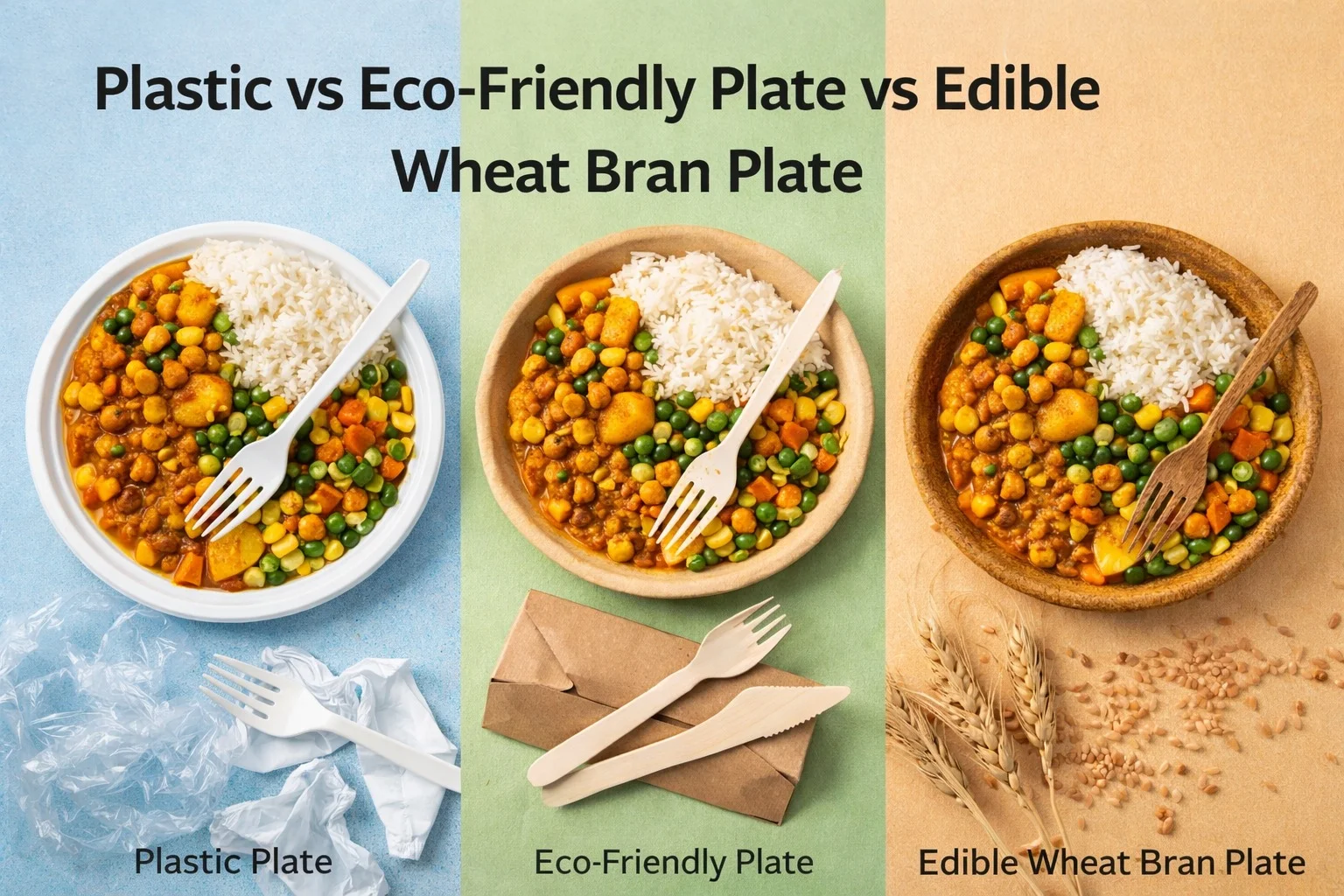
| Plate Type | Environment Friendly (Practical) | Emotional Comment (Public Perception) | Animal Feed | Reuse | Need Pit/Compost Facility | Decomposition Time |
| Wheat Bran / Rice Bran (Edible) | Very high – made from wheat bran waste “ zero waste” | “Feels natural and guilt-free; even edible or feedable” 🌾 | ✅ Yes | ❌ No | ❌ No | 30 days |
| Paper Plate | Moderate – often coated with plastic film | “Looks eco but people doubt its real sustainability” | ❌ No | ❌ No | ⚠️ Sometimes | 2–6 months |
| Thermocol (Styrofoam) | Very poor – petroleum based | “Cheap but environmentally irresponsible” | ❌ No | ❌ No | ❌ No | 500+ years |
| Plastic Disposable | major pollution source | “Convenient but socially criticized” | ❌ No | ⚠️ Sometime | ❌ No | 400–500 years |
| Bamboo Plate | High – renewable natural fiber | “Premium eco image; feels modern & sustainable” 🎋 | ❌ No cardboard in bottom of plate | ⚠️ Limited | ❌ No | 3–6 months |
| Bagasse (Sugarcane fiber) | High – made from sugarcane waste | “Popular eco-friendly catering option” | ❌ No | ❌ No | ⚠️ Better in compost | 60–120 days |
| Areca Leaf Plate | Very high – naturally fallen leaves | “Traditional, rustic and authentic eco feel” 🌴 | ❌ No | ⚠️ Sometimes | Compost facility | 60–90 days |
| Leaf Plate (Sal / Banana) | Very high – completely natural but they cause of deforestation | “Culturally respected and organic feel” 🍃 | ❌ No Stitched / paper or plastic between in the lyre . | ❌ No | ❌ No | 30–60 days |
| Corn Starch (PLA Bioplastic) | Medium – biodegradable but needs industrial compost | “Marketed as eco but many people confused about disposal” | ❌ No | ❌ No | ⚠️ Yes (industrial compost) | 3–6 months |
The Plate on Your Table Is a Choice. Make It Count.
Every year, India alone uses billions of disposable plates at weddings, street stalls, corporate events, and religious gatherings. Most of them are used for 15 minutes. Some of them will outlive your grandchildren.
The plate you hand a guest isn’t just a serving vessel — it’s a statement about what you value. This article breaks down three categories head-to-head: the plastic plate we’ve normalized, the “eco-friendly” alternatives we’ve started reaching for, and the edible wheat bran plate most people haven’t heard of yet.
What We’re Actually Comparing
Before diving in, let’s be honest about what matters:
- Environmental cost — from raw material to landfill
- After-use reality — what actually happens when the meal is over
- Public perception — how guests and buyers feel about each
- Practical value — cost, durability, and real-world usability
Plastic Disposable Plate
The Convenient Villain
Plastic plates are everywhere because they work. They’re cheap, lightweight, waterproof, and structurally sound even with heavy curries and gravies. For a caterer running a 2,000-person event on a tight budget, plastic is the path of least resistance.
But the cost isn’t on the invoice. It’s in the soil, water, and atmosphere.
The real numbers:
- Decomposes in 400–500 years
- Made from petroleum — a non-renewable resource
- Often ends up in landfills, rivers, or open burning
- Microplastics from degrading plastic plates have been found in human blood and breast milk
- Banned or restricted in multiple Indian states — yet enforcement is patchy
What people say about it: “Convenient but I feel guilty using it.”
That guilt is data. Society has already delivered its verdict on plastic. The question is whether the market has caught up.
The honest case for it: Cost. At ₹1–2 per plate at scale, nothing else competes purely on price. For low-income community events where margins are razor-thin, this is the uncomfortable reality.
Eco-Friendly Plates (Bagasse, Bamboo, Areca Leaf, Paper)
Better — But Read the Fine Print
The “eco-friendly” category is not one thing. It’s a spectrum, and marketing has blurred the lines significantly.
Here’s the truth about the most common options:
Bagasse (Sugarcane fiber) Made from sugarcane waste — the pulp left after juice extraction. Genuinely circular. Decomposes in 60–120 days, handles heat and moisture well, and is widely used in catering. The catch: composting is faster in industrial facilities, which most Indian cities don’t have.
Bamboo Plate Premium feel, renewable material — but most bamboo plates have a cardboard or paper base layer that complicates composting. Not as clean as it looks. Decomposes in 3–6 months. Carries a strong aspirational image: modern, sustainable, Instagram-worthy.
Areca Leaf Plate Made from naturally fallen areca palm sheaths — no tree is cut, no chemicals used. Genuinely impressive. Decomposes in 60–90 days. Rustic, traditional look that resonates deeply at cultural events. The limitation: supply is regional and volume inconsistent.
Paper Plate The biggest perception gap in this entire comparison. Paper plates look responsible — but most are coated with a plastic or wax film to resist moisture. That coating means they cannot be composted and often can’t be recycled either. A paper plate going to landfill is barely better than a plastic one.
What people say about eco plates: “I feel better using these — but I’m honestly not sure if they’re actually better.”
That uncertainty is the category’s core problem. Without clear labeling and consumer education, “eco-friendly” becomes a feeling, not a fact.
Edible Wheat Bran / Rice Bran Plate
The Option That Makes Every Other Option Look Incomplete
This is where the conversation changes entirely.
Wheat bran plates are made from the outer layer of wheat grain — agricultural waste that would otherwise be discarded or burned. The manufacturing process uses no plastic, no coating, no chemical binders. The plate itself is fully edible.
Let that settle for a moment.
After your guest finishes eating:
- The plate can be fed to cattle or birds — it’s food
- If composted, it breaks down in under 30 days
- If it ends up in open land, it simply returns to soil
- There is no landfill scenario — every end-of-life path is clean
The practical reality:
- Structurally sound for dry and semi-wet foods
- Holds shape through a typical meal
- Naturally neutral flavour — doesn’t affect food taste
- Cost is higher than plastic but falling as production scales
- Not ideal for very liquid gravies without a leaf liner
What people say about it: “Feels natural and guilt-free — honestly didn’t know this existed.”
That last part — didn’t know this existed — is the biggest obstacle wheat bran plates face. Not performance. Not price. Awareness.
The Greenwashing Problem Nobody Talks About
Here’s the uncomfortable truth about the eco-friendly category: it has a credibility problem.
A bamboo plate with a cardboard base, manufactured in a factory with coal power, shipped 2,000 km, and thrown in a bin with no composting infrastructure — is it really eco-friendly? Compared to what baseline?
Corn starch (PLA) plates are perhaps the most egregious example. Marketed heavily as biodegradable, they require industrial composting at 60°C+ to break down. In a home bin or landfill, they behave almost identically to plastic. Yet they carry an “eco” label and command a premium price.
Wheat bran plates sidestep this problem entirely. There is no disposal infrastructure required. There is no greenwashing possible. The plate is food. Food doesn’t need a composting facility — it just needs to exist.
Who Should Choose What
Choose plastic if: You’re at a point of absolute budget constraint and have no alternatives. At least be honest about the tradeoff.
Choose eco-friendly plates if: You want a reliable, scalable middle ground. Go for bagasse or areca leaf — they have the best-verified environmental credentials in the category. Avoid paper plates unless they’re explicitly certified compostable.
Choose wheat bran plates if: You want to serve a meal and make a statement. For weddings, brand events, eco-conscious catering, or anywhere your guests’ values align with sustainability — this is the conversation starter and the category winner.
The Bottom Line
Plastic plates are a 15-minute convenience with a 500-year consequence.
Eco-friendly plates are a genuine improvement — but the category needs scrutiny, not blind trust.
Edible wheat bran plates are the most complete answer to the question: what happens after the meal? — because the answer is simply: nothing bad.
The plate on your table is a choice. The question is whether that choice reflects what you actually believe about the world you’re feeding your guests in.